People Care: Human Thriving & Agency
Design shapes our bodies, attention, relationships, choices, and possibilities. This section asks how digital creators can support human agency, accessibility, meaningful connection, and well-being rather than simply maximizing engagement and profit.
The course is guided by Permaculture Design Ethics: Earth Care, People Care, and Fair Share. Rooted in the millennia-old patterns of thriving ecosystems, these ethics provide key values and questions for our designs. They return in every project critique and portfolio reflection.
 Permaculture Ethics: Earth Care, People Care, Fair Share
Design Shapes Us
Design is how we build our world—from its intimate effects on our bodies to its consequences for communities and ecosystems. How and why we design shapes our tools; in turn, those tools shape who we are and who we can become.
The technological revolution has unfolded so quickly that many consequences of our designs were never adequately tested on people, communities, or ecosystems. Today, growing calls for more holistic and healthy design principles challenge creators to align their work with the world they want to help create.
We begin with technology’s effects on people, particularly the human body. New media theorist Marshall McLuhan describes technologies as extensions of the body: when a technology augments one human capacity, it may weaken or “amputate” another. Recognizing these trade-offs is essential to good design and humane technology.
People Care | Fair Share | Earth Care |
|---|---|---|
| Supports autonomy, attention, health, accessibility, dignity, and meaning. | Asks who participates, who benefits, whose labor and data are used, and who bears risk. | Recognizes the material, energy, water, and infrastructure behind every digital experience. |
| Does this support human agency and thriving? | Who benefits, participates, or bears costs? | What material and ecological systems does it depend on, and how could harms be reduced or regeneration supported? |
Values, Agency & Humane Design
Core question
What values are embedded in the technologies we design, and whose agency do those choices support?
Class focus
- Meta recent $17 B fine
- design as a system of values and choices
- agency versus extraction
- convenience versus care
- AI as tool, system, and design responsibility
Quiz 1: (due Thursday 9/3) Assigned readings / viewings
- Design Justice Network — Design Justice Principles — concise values framework
- AI for Students, UNESCO Summary; OR. UNESCO — AI Competency Framework for Students — skim human-centered mindset and AI ethics sections
- Digital Wellness Lab — Teen Voices Shaping a Healthier Digital World — youth perspectives
Design
- Join class Website & create one block-based post. Use a labelled, optimized image as featured image.
- Review Digital Wellness Lab Choose one digital tool you use daily & post labelled, optimized image as featured image. Explain a-one questionable design choice, b-the value it encodes, c-who benefits, and d-one humane alternative.
- Post your a-d “Digital Wellness” explanation as “Week1-Yourname”, use category “Class”
Project
- Project 1 — Slow Media: review assignment & consider possibilities. Prep is due next week. Develop a 1–2 minute audio story or soundscape that protects attention and rewards careful listening.
Ecological Literacy for Digital Design
Core question
How can ecological principles change the way digital creators define good design?
Class focus
- Project 1 models: Sounds of Maine(needs more story), Learning how to Meet Women (from 1 in 8 Million NYT), Calm Meditations
- systems thinking and ecological feedback
- PC: small and slow solutions
- performance and sufficiency
- ecological costs hidden by interface design
Quiz 2: Assigned readings / viewings
- W3C — Web Sustainability Guidelines — read introduction and overview
- Low-Tech Magazine — About the Solar Powered Website — a working low-impact design example
- Permaculture Ethics — Earth Care, People Care, Fair Share — course framework; read all 4 sections (follow bicycle > )
Design
Map one digital artifact from user need to device, network, server, and disposal. Try to list all energy and materials and labor and transportation needed to make the task happen. Make one small change that reduces unnecessary resource use, or unfair labor.
Project
- Project 1 — Slow Media PREP: draft a 1–2 minute audio story or soundscape that protects attention and rewards careful listening.
Optional accessibility practice
Add useful alt text to one portfolio image and check one text/background pair for WCAG contrast. Fix either if needed.
Optional
Attention, Persuasion & Humane Defaults
Core question
When does helpful persuasion become manipulation, and how can designers protect attention?
Class focus
- attention as a finite human resource: Still Face video
Play & attunement & Stillface w phone - persuasive design and dark patterns
- infinite scroll, autoplay, notifications, and defaults
- recording and editing for deliberate pacing: Improve your Focus
Quiz 3: Assigned readings / viewings
- Pew Research Center — Teens’ Experiences on TikTok, Instagram and Snapchat — current user evidence
- Federal Trade Commission — Bringing Dark Patterns to Light — design patterns and consumer harm
- Digital Wellness Lab — Would You Give 25 Years of Your Life to an App? — youth voice
Design
Find one dark pattern or attention-hijacking default. Redesign it as a humane default that still lets the service accomplish a legitimate goal.
Project
- Project 1 — Slow Media: Complete your 1–2 minute audio story or soundscape that protects attention and rewards careful listening.
Intentional Technology & Humane Friction
Core question
Which forms of friction protect attention and judgment, and which merely obstruct people?
Class focus
- good friction versus bad friction
- limits, recovery, and focus
- trade-offs in bans and defaults
- revision as intentional design
Quiz 4: Assigned readings / viewings
- Stanford — How Do Smartphone Bans Impact Students? — mixed effects on attention, learning, and well-being
- Stanford Institute for Economic Policy Research — Effects of School Phone Bans — national evidence Summary & Full Article
- Digital Wellness Lab — You Locked the Phone, But Forgot to Unlock the Classroom — student perspective
Design
Run a one-day notification or interruption experiment. Record what improved, what became harder, and redesign one interaction using purposeful rather than punitive friction.
Project Due 2/27
- Project 2: digital detox via research, reflection, trial & visualization .
Optional accessibility practice
For Project 1 or a portfolio post, provide a readable transcript and use descriptive link text rather than “click here.” or “learn more”
Optional
Connection, Well-Being & Human Needs
Core question
How can digital systems support belonging and creativity without substituting engagement metrics for human needs?
Class focus
- well-being beyond screen-time totals
- social connection versus social metrics
- AI companions and relational design
- designing for rest, limits, and recovery
Quiz 5: Assigned readings / viewings
- Pew Research Center — Teens, Social Media and Mental Health — benefits and harms
- Common Sense Media — Talk, Trust, and Trade-Offs: Teens and AI Companions — emerging mediated relationships
- Digital Wellness Lab — The Highlight Reel vs. Real Life — student voice
Design
Choose one human need—belonging, competence, rest, creativity, safety, or autonomy—and sketch a feature that supports it without maximizing time-on-platform.
Project Due 10/4
- Project 2: digital detox via research, reflection, trial & visualization.
II — Fair Share: Community, Justice & Collective Agency
Digital systems do more than connect people. They distribute visibility, opportunity, risk, data, labor, and power. Every design decision helps determine who is represented, who is excluded, who benefits, and who bears the costs.
This section shifts from individual experience to relationships, communities, culture, and democratic life. Fair Shareasks: Who benefits? Who decides? What responsibilities and resources should be shared or returned to the community?
Design emphasis
- Representation, consent, and design justice
- Media provenance, credibility, and verification
- Privacy, surveillance, and data power
- AI as a system of social and political choices
- Technology that strengthens communities and respects cultural difference
We will continue to evaluate every design through the connected lenses of People Care, Fair Share, and Earth Care, with Fair Share as our primary focus.
In Part I, People Care Design, Tristan Harris’s “Call to Minimize Distraction & Respect Users’ Attention” helped us examine how the attention economy affects physical and mental health. Part II expands the scale of inquiry: How does digital technology shape families, relationships, communities, cultures, and political systems?
You are not only a user of these systems. As a designer, you can challenge harmful defaults and create alternatives that reflect your values. The central question is: How can we design digital technologies that share power more fairly, strengthen collective agency, and support thriving human and more-than-human communities?
Relationships, Care & Community
.Core question
How can media and technology strengthen relationships without flattening people into users, data points, or stereotypes?
Class focus
- children, family and community dynamics
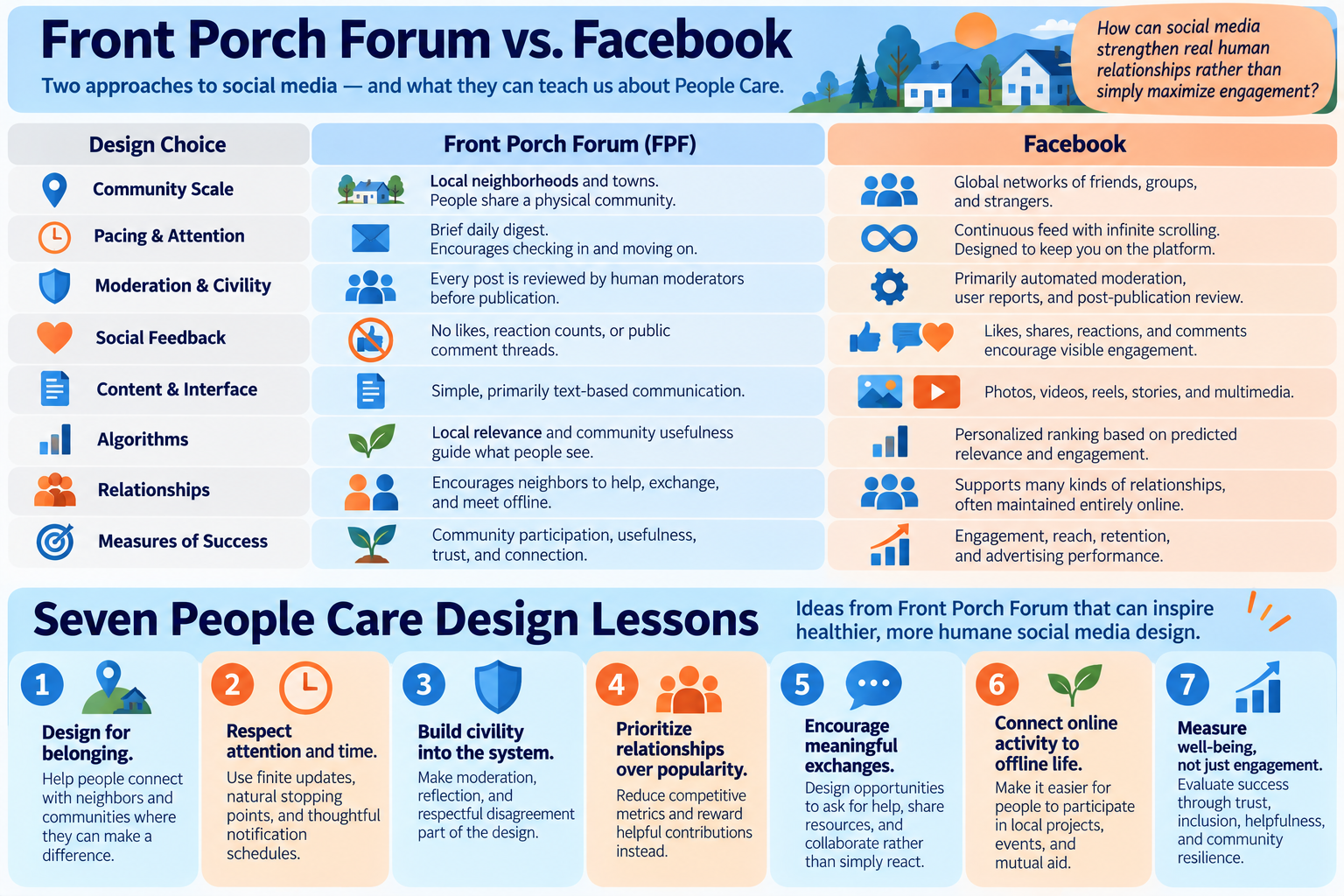
- public forums: FB vs FPF
- care, context, and dignity
- storytelling without flattening
- Front Porch Forum vs Facebook
Quiz 6: Assigned readings / viewings
- Front Porch Study, Front Porch Intro, Sample Issue, New Public & Center for Media Engagement
- Invisible Handshake, MIT Sloane B School
- Campus Games, MIT
Design
Create a stakeholder-and-care map for your Project 3 subject or community: who speaks, who is represented, who consents, and who might be affected by the story?
Project
Optional accessibility practice
Caption and give alt text for any media in your your last class post-including featured image. Then search for all of your images/media in Media library and do the same.
Optional
- American Academy of Pediatrics — Digital Ecosystems, Children, and Adolescents — design quality, development, and commercial pressures
- Pew Research Center — What Parents Say About Their Teens’ Uses of Social Media — compare with youth perspectives
- Digital Wellness Lab — More Than a Text — student voice on digital closeness and safety
- Screens & Children’s Brains–Animation
- How Has Technology Changed Families?
- Child Mind Institute — How Tech Changes Families
Bias, Representation & Design Justice
Core question
Whose assumptions become defaults in digital systems, and how can creators identify and redesign exclusion?
Class focus
- algorithmic bias and representation
- design justice
- cultural assumptions in data and interfaces
- editing for complexity rather than cliché
Quiz 7: Assigned readings / viewings
- NIST — Study Evaluates Effects of Race, Age, Sex on Face Recognition — technical evidence of uneven performance
- Design Justice Network — 10 Ways Designers Can Support Social Justice — practical design response
Design
Start with the AI Bias Activity
Then, draft a representation-and-bias audit of one interface, platform, AI feature. Identify an assumed user, an excluded or marginalized perspective, one consequence, and one redesign decision.
Lab
- Review a few Project 3 current jobs and discuss their unhealthy aspects.
- Brainstorm some better options.
- Think outside the”job” box–get inventive & fun.
Project
Synthetic Media, Provenance & Trust
Core question
How can creators establish where media came from without confusing provenance with truth? How can readers spot fake news and find ways to build trust?
Quiz 8: Assigned readings / viewings
- Center for Humane Technology — Persuasive Technology
- The Dark Art of Political Memes
- How to Spot Fake News, CUNY
- Fake News in the US, wikipedia (Information Age section at the top)
Creator move
Verify one image, quotation, clip, or claim in Project 3 using source/context checks and, when available, provenance metadata. Record what the evidence can and cannot establish.
Class focus
- deepfakes and synthetic media
- source verification, cognitive bias , ignorance
- skepticism vs cynicism

Optional accessibility practice
Check any links in your previous posts–use a more descriptive name for the link.
Project connection
Deep Fake examples
Privacy, Consent & Data Power
Core question
What data does a digital experience really need, and who gains power when designers collect more?
QUIZ 9 Assigned readings / viewings
Creator move
Draw a simple data-flow map for one app or your Project 4 concept: what is collected, where it goes, who can access it, what is truly necessary, and what could be deleted or kept local?
Class focus
- surveillance issues–who gathers & who controls information
- privacy as social as well as personal
- consent and data minimization
Project connection
- Project 4 Prep — Nothing Due. Ponder an issue that’s critical for college age adults that would make a good social media campaign.
Optional
- The Conversation — Surveillance Apathy Is a Problem
- Surveillance Self-Defense , Electronic Frontier Foundation— browse the relevant practical modules
- Federal Trade Commission — A Look Behind the Screens — platform data practices
AI, Power & Democratic Agency
Core question
How should creators decide when AI expands human agency and when it concentrates power or substitutes automated judgment?
Quiz 10 Assigned readings / viewings
- NIST — Generative AI Profile — skim risks on pages 1-12
- Freedom House — Freedom on the Net 2025 — AI, surveillance, censorship, and political power
- Digital Wellness Lab — Using AI to Augment, Not Replace Our Learning — student perspective
Creator move
Write a short AI decision memo where AI adds value, where human judgment must remain primary, one risk, one verification step, and one mitigation.
Class focus
- AI Dilemma: AI as tool, infrastructure, institution, and ideology
- automation versus agency
- verification and accountability
- power, governance, and democratic participation
Optional accessibility practice
Try using only a keyboard to navigate class webpage. Note any focus, heading, link problem you encounter.
Project connection
- Project 4 Prep — Instagram Campaign. Due 11/8
III — Earth Care: Regenerative Digital Systems
Digital media is not weightless. It depends on physical infrastructure: devices, minerals, factories, networks, data centers, electricity, water, land, and labor. These systems have already caused deep ecological damage. This section asks how digital creators can move beyond reducing harm to help restore the living systems on which all technology—and all life—depends.
Design progression
Economic logic → commons and alternatives → material lifecycles → digital infrastructure → regenerative futures
- Distinguish growth and engagement metrics from human and ecological goals
- Study digital commons, open culture, cooperatives, and reciprocal knowledge systems
- Trace device lifecycles, including extraction, manufacturing, repair, reuse, and e-waste
- Map the effects of AI and data centers on energy, water, land, labor, and communities
- Apply circularity, sufficiency, reciprocity, and regeneration to design
All economies operate within ecologies: both organize and distribute natural and human resources. Yet many current systems are designed to maximize short-term profit while depleting the soil, water, biodiversity, climate stability, and communities that make long-term prosperity possible.
Our design goal is to move from:
diagnosis → alternatives → regenerative design → paradigm shift
Regenerative design does more than make technology “less harmful.” It seeks to repair damaged systems, rebuild natural capital, and create the conditions for people and ecosystems to thrive together.
You are not limited to inheriting today’s extractive systems. As a regenerative designer, you can question their assumptions, imagine compelling alternatives, and help build technologies that return more than they take. Throughout this work, we will connect Earth Care to People Care and Fair Share, balancing critical analysis with creative vision.
The central question is: How can we design digital systems that serve life, restore ecological capacity, and help create a thriving future?
Related viewings
- This Changes Everything
- How to Get a Climate Tech Job
- Climate Action Tech – See their Slack channel
Economies for Human & Planetary Thriving
Core question
What should technological systems optimize if growth, engagement, and profit are not adequate measures of success?
Quiz 11 Assigned readings / viewings
- Doughnut Economics Action Lab — What Is the Doughnut? — social foundation and ecological ceiling
- Doing the Doughnut Tech — Change the Goal — apply ecological economics to technology
- Jason Hickel — Less Is More
Creator move
Map the business model of one digital service. What does it optimize? Identify one alternative success metric grounded in People Care, Fair Share, or Earth Care.
Class focus
- economic design as technological design
- growth metrics versus human/ecological goals
- feedback, externalities, and sufficiency
- creative work in a changing technological economy
Project connection
- Project 4 Due 11/15
Optional
- Post Carbon Institute — The Big Picture
- Peter Barnes — Capitalism 3.0 / Reclaiming the Commons
- The Small Things Manifesto
- World Economic Forum — Future of Jobs Report 2025: Digest — technology literacy, creative thinking, and environmental stewardship
Commons, Open Culture & Cooperative Infrastructure
Core question
What changes when knowledge, tools, and infrastructure are designed for shared stewardship rather than extraction?
Quiz 12 Assigned readings / viewings
- Digital Commons Cooperative — Principles of Movement-Led Technology — community-led infrastructure
- Shareable — The Solidarity Economy
- Creative Commons — From Signals to Infrastructure: Strengthening the Commons for the AI Era — reciprocity and AI-era commons
Creator move
Take one extractive or proprietary service and sketch a commons, cooperative, interoperable, or community-governed alternative. Specify what would be shared and how stewardship would work.
Class focus
- digital commons and open culture
- reciprocity, attribution, and stewardship
- cooperative and community infrastructure
- local resources and mutual support
Optional accessibility practice
For Project 5, provide captions or a transcript and check that any on-screen text remains readable long enough and at sufficient contrast.
Project connection
Optional
Digital Footprint: Extraction, Devices, Repair & E-Waste
Core question
What would digital products look like if designers treated devices as material lifecycles rather than disposable endpoints?
Quiz 13 Assigned readings / viewings
- ITU / UNITAR — Global E-waste Monitor 2024 — read key findings / executive material
- Doing the Doughnut Tech — Create to Regenerate — longevity, repair, reuse, and circular design
Creator move
Choose one device you own and map extraction/materials → manufacture → use → repair → reuse → disposal. Identify one design or behavior change that could extend its useful life.
Class focus
- material footprint of digital devices
- repairability and right to repair
- circularity versus planned obsolescence
- lifecycle thinking for creators
Independent student work
- Complete the device lifecycle map outside the single class meeting.
- Find one realistic local or community-scale repair, reuse, sharing, or recycling pathway.
- Begin Project 6 artist statement and organize portfolio documentation.
Project connection
- Make any missing work
All late work due by the end of Thanksgiving break
Digital Infrastructure: AI, Data Centers, Energy, Water & Communities
Core question
What physical systems make digital experiences possible, and how should creators weigh their benefits against energy, water, land, and community costs?
Quiz 14 Assigned readings / viewings
- International Energy Agency — Key Questions on Energy and AI — current quantitative overview
- World Resources Institute — 7 Ways Data Centers Affect U.S. Communities — energy, water, land, air, costs, and equity
- W3C — Web Sustainability Guidelines — revisit infrastructure and hosting recommendations
Creator move
Map one digital service across user device → network → cloud/data center. Note likely energy, water, land, or community dependencies, then propose one demand-reduction or design intervention.
Class focus
- data centers as physical infrastructure
- AI electricity demand
- water, land, grids, taxation, and community consent
- demand reduction before efficiency claims
Optional accessibility practice
Run a brief accessibility-and-performance review of one portfolio page. Fix one accessibility barrier and one unnecessarily heavy asset.
Project connection
Regenerative Design Futures: Circularity, Commons & Solarpunk
Core question
How can creators move beyond doing less harm toward technologies that strengthen communities and living systems?
Quiz 15 Assigned readings / viewings
- Doing the Doughnut Tech — Create to Regenerate — regenerative technology principles
- Creative Commons — Update on CC Signals — reciprocity and the AI-era commons
- Open Source Ecology — Overview — open, repairable, locally productive systems
Creator move
Take one project from this semester and redesign it one step further using all three lenses: increase human agency, distribute benefits and governance more fairly, and reduce extraction or support regeneration.
Class focus
- regeneration versus mitigation
- circularity, sufficiency, and reciprocity
- commons and local resilience
- solarpunk as design speculation grounded in practical systems
Project connection
- Project 6 — Designer’s Portfolio Final
- curate the semester as evidence of values-driven design judgment.
Final Portfolio — Synthesis & Reflection
Core question
What kind of digital creator are you becoming, and how does your work support human thriving, fair participation, and ecological health?
Final reflection
This week is for synthesis, revision, and reflection. Choose evidence from your projects to address all three course lenses:
- People Care: how your design supports agency, attention, accessibility, health, dignity, or meaning;
- Fair Share: how your design handles participation, representation, consent, data, labor, ownership, or community benefit;
- Earth Care: how your design recognizes material and infrastructure costs and moves toward sufficiency, repair, sharing, circularity, or regeneration.
Include a short AI-use reflection across the portfolio: where AI was useful, where you chose not to use it, what you verified, and where human judgment remained essential.
Project 7 — Eco-Designer’s Portfolio
Review the existing Portfolio Tips and submit according to the course schedule.
AI Exploration Across the Course
AI is treated as a recurring design condition rather than a single topic. For each major project, students briefly disclose whether AI was used, what it contributed, what they verified, and why that use supported rather than replaced core design judgment.